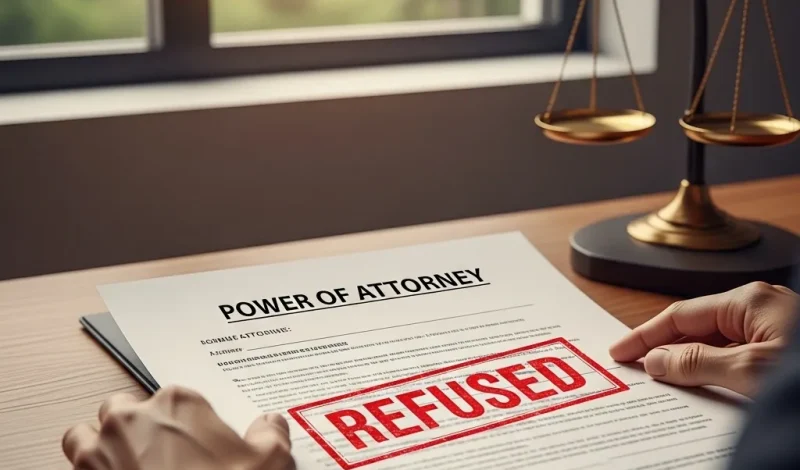

What to Do If a Power of Attorney Is Refused in Florida: Enforcing Your Rights
Quick Answer: What to Do If a Power of Attorney Is Refused in Florida?
If a bank or institution in Florida refuses a valid Power of Attorney, the agent should immediately demand a written explanation for the rejection. Under Florida Statute § 709.2120, third parties cannot arbitrarily refuse a document; they must accept it, request an affidavit, or provide a legal reason for refusal within a reasonable time (typically four business days). To overturn the denial, agents should submit a sworn agent’s affidavit or an attorney opinion letter confirming the document’s validity. Unreasonable refusal can make the institution liable for damages and attorney’s fees.
When a bank, nursing home, or title company rejects a valid Power of Attorney (POA), it stops families from paying bills or accessing essential funds. However, Florida law strictly prohibits institutions from arbitrarily refusing valid documents. Agents have specific statutory tools to force acceptance.
In Florida, “third parties” (banks, brokerages, etc.) cannot simply say “no” because they are unfamiliar with your specific document format. Under Florida Statute § 709.2120, they must accept the document, request an affidavit, or provide a written legal reason for the refusal within a specific timeframe.
Understanding Why Florida Institutions Reject POAs
It is rarely personal; it is almost always about liability. Banks fear that if they release funds to an unauthorized agent, they will be sued by the principal (the account owner) later.
However, risk aversion is not a legal justification for refusal.
While a teller may reject a document because it “looks old” or “isn’t on our specific form,” Florida law states that a copy of a properly executed Durable Power of Attorney is just as valid as the original, and internal bank forms cannot be mandatory if the statutory document is sufficient.
The “Third-Party Acceptance” Statute (F.S. § 709.2120)
This is the most important law for agents to know. It shifts the burden from you to the bank.
Under this statute, a third party must do one of three things within a “reasonable time” (usually 4 business days):
- Accept the Power of Attorney.
- Request an affidavit or an opinion of counsel to clarify a specific legal question.
- Reject the document in writing, stating exactly why it is being refused.
They cannot simply remain silent, delay indefinitely, or refuse verbally without explanation.
Step-by-Step: How to Challenge a Wrongful Refusal
If you are standing at a bank counter in Tampa and are being told your document is “no good,” follow this escalation process immediately.
1. Demand the Refusal in Writing
Do not accept a verbal “we can’t take this.” politely ask the manager for a written statement of refusal as required by Florida Statute § 709.2120.
- Why this works: It signals that you know the law. Most frontline staff will immediately escalate this to their legal department, where actual lawyers (who know they can’t arbitrarily refuse) will review it.
2. Cure the “Defect” with an Affidavit
If the rejection is because the bank is unsure if the principal is still alive or if the document is still active, you can “cure” this fear by signing a sworn affidavit.
- Once you sign this affidavit, the bank is generally relieved of liability if you turn out to be lying. This often removes their hesitation to accept the document.
3. Obtain an Attorney Opinion Letter
If the bank claims the wording in your POA is ambiguous (e.g., unclear authority to sell real estate or change beneficiaries), they may request an Opinion of Counsel.
- This is a formal letter from a Florida attorney stating that, in their professional legal opinion, the document is valid and grants the requested authority.
4. Legal Enforcement (The Last Resort)
If the institution continues to refuse a valid POA after you have provided the affidavit and opinion letter, they may be acting in “bad faith.” At this point, legal intervention is necessary.
Common Questions About Power of Attorney Rejection & Invalidity
Can a power of attorney be rejected?
Yes, but not arbitrarily.
Under Florida Statute § 709.2120, a third party (like a bank or title company) can refuse a Power of Attorney if they have “actual knowledge” that the document is invalid, revoked, or if the agent is acting beyond their authority. However, they cannot reject it simply because it is an out-of-state document or “too old.” If they reject it, they are legally required to provide a written explanation within a reasonable timeframe.
What makes a POA invalid in Florida?
A Florida Power of Attorney is considered legally invalid if:
- Improper Execution: It lacks the signature of the principal, two witnesses, and a notary public (a strict requirement since 2011).
- Incapacity at Signing: The principal was not mentally competent at the moment they signed the document.
- Revocation: The principal signed a new document explicitly revoking the old one, or destroyed the original with intent to revoke.
- Death of Principal: The document becomes void immediately upon the principal’s death.
Can a POA withdraw money from a bank account after death?
No. Absolutely not.
This is a critical rule: A Power of Attorney expires the exact moment the principal dies.
Any attempt to withdraw funds after the principal’s death—even to pay for their funeral—is considered unauthorized access and potentially fraud. Once the principal passes away, authority shifts to the Personal Representative (Executor) named in the Last Will and Testament, not the POA agent.
What are common POA mistakes to avoid?
To prevent rejection, avoid these drafting and usage errors:
- “Springing” Powers: Florida law (post-2011) removed “springing” powers (which only activate upon incapacity) for new documents because they cause massive delays while doctors verify incapacity.
- General “Blanket” Language: Banks often reject vague terms like “all banking powers.” The document should explicitly list authority (e.g., “access safe deposit box,” “create trusts”).
- Missing “Super Powers”: Authority to change beneficiaries or gift money must be separately initialed by the principal.
What makes a power of attorney void?
A Power of Attorney becomes void (unenforceable) in Florida when:
- The principal dies.
- The principal revokes the document while competent.
- A court enters an order determining the principal is incapacitated and suspends the POA in favor of a court-appointed guardian.
- The purpose of the POA is completed (if it was a “limited” POA for a specific transaction).
Which of the following is a red flag for power of attorney (POA)?
Banks and institutions are trained to look for “red flags” that suggest financial exploitation, including:
- Sudden Large Withdrawals: The agent withdraws cash immediately after gaining access.
- New Beneficiaries: The agent attempts to change “Pay on Death” (POD) beneficiaries to themselves.
- Silence from Principal: The agent refuses to let the bank speak to the principal directly.
- Brand New Documents: A POA signed very recently by an elderly person with known memory issues (dementia/Alzheimer’s).
What is a “POA Denial”?
A POA Denial is a formal refusal by a third party to honor the agent’s authority. In Florida, this is a statutory process. It is not just a teller saying “no”; it is a legal determination that the institution is unwilling to accept liability for the agent’s actions, usually requiring an affidavit or attorney opinion letter to resolve.
Can You Sue a Bank for Refusing a Power of Attorney?
Yes. Florida legislation includes “teeth” to ensure institutions respect these documents.
If a court finds that a third party unreasonably refused to accept a valid Power of Attorney:
- Court Order: The judge can issue a mandate forcing the bank to accept the document.
- Damages: You may sue for financial losses caused by the delay (e.g., late fees, lost real estate deals).
- Attorney’s Fees: Crucially, the statute allows the prevailing party to recover attorney’s fees and costs.
Note: The threat of paying your legal fees is often enough to make a bank’s legal department reverse a rejection quickly without actually going to trial.
How AWS Law Resolves “Frozen” Accounts
When a bank refuses to cooperate, you don’t have time to argue with customer service while medical bills stack up. AWS Law intervenes on behalf of agents in Tampa and surrounding Florida areas to resolve Power of Attorney-related account freezes, which often arise during estate planning or elder care situations handled by Tampa Estate Planning Attorneys and Tampa Elder Law & Medicaid Planning Attorney.
AWS Law takes swift legal action to:
- Review the specific reasons for rejection, including whether the refusal violates Florida Power of Attorney laws
- Draft the necessary statutory affidavits to cure defects and address bank liability concerns
- Issue formal Attorney Opinion Letters that satisfy bank compliance officers
- File enforcement actions against institutions acting in bad faith, including cases that may escalate into guardianship matters requiring a Tampa Guardianship Attorney
For agents facing immediate refusal issues, AWS Law also provides focused Power of Attorney Tampa Services to help restore access to frozen accounts without unnecessary delay.
Is the bank refusing your request? Contact AWS Law immediately. We help you get your Power of Attorney approved quickly.